

Offshore floating hydrogen plant is being developed off the coast of Scotland
Release time:
Apr 12,2022
A floating offshore hydrogen production plant is being developed off the coast of Scotland
According to Global Hydrogen Energy Network, ClassNK, a Japanese classification society, has granted in principle approval (AiP) to a floating offshore hydrogen plant jointly developed by the Japan Deepwater Engineering Platform Technology and Engineering Research Association (J-DeEP) off the coast of Scotland.
The hydrogen production platform will be powered by surplus electricity generated by wind turbines. It will combine a seawater desalination system and a system to extract hydrogen from water through electrolysis. The project is being developed in collaboration with the international department of the Scottish government and Scottish Development International, which has helped J-DeEP complete a feasibility study.
The organization stated in a press release, "ClassNK conducted a safety assessment of the plant's design based on J-DeEP's specifications and guidelines. After confirming that the design met relevant requirements, ClassNK issued the AiP."
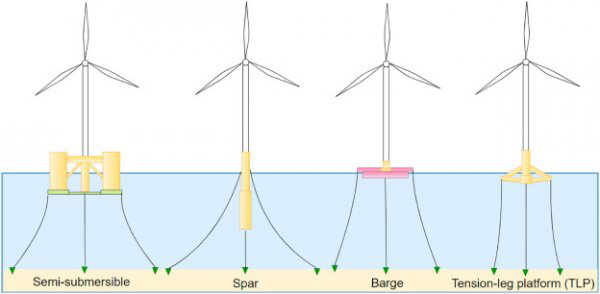
According to a recent study by University College Cork in Ireland, combining high-capacity offshore floating wind energy with green hydrogen production could be an important opportunity for further decarbonization of the energy industry. The scientists proposed three types of project scenarios based on variables such as electrolyzer technology, floating wind power platforms, and energy transmission. These scenarios include offshore systems based on centralized onshore electrolysis, distributed offshore electrolysis, and centralized offshore electrolysis.
The scientists said, "The energy transmission method is a key feature of these three types, and the main components of the system are discussed to limit the complexity of the paper while highlighting more detailed topics for future analysis."
They found that the centralized system design is simpler than the distributed system design as it offers more economical options for certain components.
"For example, large-scale development efforts currently underway may result in more cost-effective large-scale electrolyzers, leading to cheaper hydrogen. On the other hand, the challenge faced by the centralized system is that any failure would stop hydrogen production at the entire facility. The centralized offshore system also requires additional capital expenditure, namely the floating vessel for the electrolysis equipment."
(Original source: Global Energy, Global Hydrogen Energy Network, and New Energy Network)
Key words:
Related News
Contact Us
Landline:+86-0755-82967058,+86-0755-82967036
Fax:+86-0755-82967080
E-mail:fly_aline2000@aliyun.com
Address: East Block, CLE Information Building, No.1 News Road, Futian District, Shenzhen

Watch Video]

contact us]